Smoked Signals Robust Porter
Unleash the rich, complex flavours of a Smoked Signals Robust Porter. This intermediate homebrew recipe delivers deep chocolate, roasted notes, and a sophisticated beechwood smokiness.
Robust Porter · 6.5% ABV · 38 IBU · 23L · 3-4 weeks · intermediate
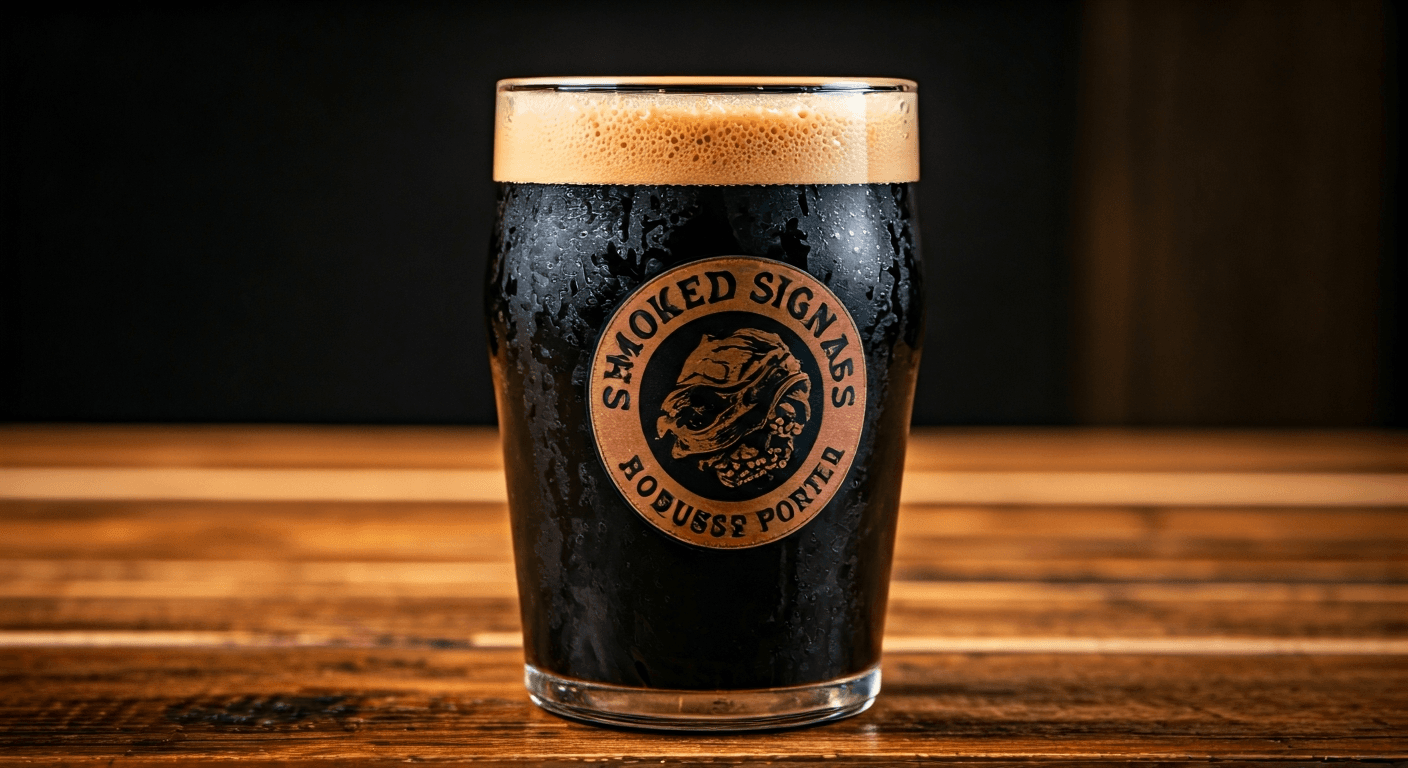
Brewing figures
- Original gravity
- 1.068
- Final gravity
- 1.018
Equipment Needed
Large brew kettle (min. 30L capacity)
Mash tun or large insulated cooler (min. 30L capacity)
Hot liquor tank or separate pot for heating strike water
Fermentation vessel (25L+ capacity, e.g., plastic fermenter or glass carboy)
Airlock and bung
Hydrometer and test jar
Thermometer (accurate digital recommended)
Long stirring spoon or paddle
Grain bag (if using BIAB) or false bottom/manifold for mash tun
Sanitiser (e.g., Star San, VWP)
Bottling bucket with spigot OR kegging setup
Bottles (approx. 46 x 500ml) or a keg
Bottle filler and capper (if bottling)
Measuring jugs and scales
Ice bath or wort chiller
Ingredients
Fermentables (for 23L batch)
5.5 kg (12.1 lbs) Maris Otter Pale Malt
450 g (1 lb) Brown Malt
350 g (0.77 lbs) Chocolate Malt
250 g (0.55 lbs) Weyermann Rauchmalz (Beechwood Smoked Malt)
100 g (0.22 lbs) Crystal Malt (60L)
Hops
40 g Challenger Hops (7.5% AA) @ 60 minutes
10 g Challenger Hops (7.5% AA) @ 15 minutes
Yeast
2 x 11.5g packets SafAle US-04 Dry English Ale Yeast (rehydrated as per instructions)
(Alternatively, a liquid English Ale yeast like Wyeast 1028 London Ale or White Labs WLP002 English Ale, with a 2L starter)
Other
Whirlfloc tablet or Irish Moss (5g) @ 10 minutes (for clarity)
Water (approx. 28-30L strike water, 10-12L sparge water)
5g Yeast Nutrient @ 10 minutes (optional, but recommended)
150g Dextrose (Corn Sugar) or 120g Table Sugar (for bottling)
Mashing Instructions
Target Mash Temperature: 67°C (152°F)
Mash Time: 60 minutes
Heat Strike Water: Calculate your strike water volume. For a 23L batch with 6.65kg of grain, you'll need approximately 22-25 litres of strike water, aiming for a mash thickness of about 3L/kg. Heat this water to around 72-74°C (162-165°F) to account for heat loss when adding to the grains.
Dough In: Carefully add your crushed grains to your mash tun, stirring thoroughly to ensure there are no dry clumps (dough balls). Aim for a consistent mash temperature of 67°C (152°F). Adjust with small additions of hot or cold water if necessary.
Mash Rest: Close your mash tun and insulate it well. Let the mash rest for 60 minutes. This allows the enzymes to convert starches into fermentable sugars.
Mash Out (Optional but recommended): After 60 minutes, slowly raise the mash temperature to 77°C (170°F) by adding boiling water or applying direct heat (if your mash tun allows). Hold for 10 minutes. This stops enzyme activity and makes the wort less viscous, aiding sparging.
Recirculate (Vorlauf): Before collecting your wort, slowly open the spigot on your mash tun and collect about 1-2 litres of wort. Gently pour this back over the grain bed until the wort runs clear. This sets the grain bed as a filter.
Sparge: Begin collecting your wort into your boil kettle. Slowly add sparge water (heated to 77°C / 170°F) to the top of the grain bed as you drain, maintaining a consistent liquor level just above the grains. Continue until you have collected approximately 27-28 litres of wort in your boil kettle.
Boiling & Hopping
Boil Time: 60 minutes
Bring to a Boil: Once you have collected your wort, bring it to a rolling boil. Keep an eye out for boil-overs as the hot break forms.
First Hop Addition (60 min): As soon as the boil starts, add 40g of Challenger Hops. This provides the primary bitterness for your porter.
Second Hop Addition (15 min): With 15 minutes remaining in the boil, add 10g of Challenger Hops and your Whirlfloc tablet/Irish Moss and yeast nutrient (if using).
End of Boil: After 60 minutes, turn off the heat.
Chill the Wort: Rapidly cool the wort down to fermentation temperature (18-20°C / 64-68°F) using an immersion chiller, plate chiller, or by placing the kettle in an ice bath. Rapid cooling helps to prevent off-flavours and reduce the risk of infection.
Fermentation
Sanitise: Thoroughly clean and sanitise your fermentation vessel, airlock, and bung.
Transfer Wort: Carefully transfer the chilled wort to your sanitised fermentation vessel. Try to minimise splashing during transfer to avoid aerating the hot wort, but once it's cool, splashing is good to introduce oxygen for the yeast.
Take OG Reading: Use your hydrometer to take an Original Gravity (OG) reading. Record this for later ABV calculation. Target OG: 1.068-1.070.
Pitch Yeast: Rehydrate your two packets of SafAle US-04 yeast according to the manufacturer's instructions, then pitch it into the wort. If using liquid yeast, ensure your starter is ready and pitch it.
Seal and Ferment: Secure the lid on your fermenter, insert the airlock (filled with sanitiser solution), and place it in a dark, temperature-controlled environment.
Primary Fermentation: Ferment at 18-20°C (64-68°F) for approximately 10-14 days. You should see active bubbling in the airlock within 24-48 hours.
Check FG: After 10-14 days, take a Final Gravity (FG) reading. If it's stable over two consecutive days and within the expected range (target FG: 1.017-1.019), fermentation is complete.
Conditioning (Optional but Recommended): Once primary fermentation is complete, you can transfer the beer to a secondary fermenter for conditioning for another 1-2 weeks at cellar temperature (around 12-16°C / 54-61°F). This helps clear the beer and develop flavours, reducing yeast contact. Alternatively, you can simply leave it in the primary fermenter for the full 3-4 weeks.
Bottling/Kegging
Sanitise: Ensure all bottling/kegging equipment (bottling bucket, bottles, caps, filler, or keg) is thoroughly cleaned and sanitised.
Prepare Priming Sugar: Dissolve 150g Dextrose (corn sugar) or 120g Table Sugar in 250ml of boiling water. Let it cool slightly.
Transfer to Bottling Bucket/Keg: Gently siphon the conditioned beer from the fermenter into your sanitised bottling bucket (if bottling) or directly into your sanitised keg. Avoid transferring the yeast cake at the bottom.
Add Priming Sugar: If bottling, gently stir in the cooled priming sugar solution into the beer in the bottling bucket. Stir carefully to ensure even distribution without aerating the beer too much.
Bottle or Keg:
Bottling: Fill your bottles, leaving about 2-3 cm of headspace. Cap immediately.
Kegging: Seal your keg and carbonate to your desired level (usually 2.2-2.5 volumes of CO2 for a porter) using CO2 pressure.
Conditioning (Carbonation):
Bottles: Store bottles at room temperature (18-22°C / 64-72°F) for at least 2-3 weeks to allow for carbonation. Then move to a cool, dark place for further conditioning.
Keg: Carbonate at serving temperature for 1-2 weeks, or force carbonate over a few days.
Tips for Success
Sanitation is Key: Always clean and sanitise everything that comes into contact with your wort after it's cooled.
Temperature Control: Maintaining a consistent fermentation temperature is crucial for preventing off-flavours.
Smoked Malt Balance: The amount of Rauchmalz is judicious here to provide a subtle smokiness. If you want a more pronounced smoke character, you can increase it by up to 50% in future brews, but be careful not to overpower the other delicious malt flavours.
Patience: Good beer takes time. Don't rush fermentation or conditioning. This porter will benefit from extra time in the bottle or keg.
Record Keeping: Keep detailed notes of your brew day, including temperatures, gravities, and any observations. This helps you refine your process for future batches.
Water Chemistry: For advanced brewers, adjusting your water profile to suit a Robust Porter (e.g., slightly higher calcium and sulphate for malt backbone) can further enhance the beer.